
Ask whether the campaign has to be seen or has to be bought. Flagships buy images and a retail relationship; a rollout buys availability and a result you can measure.
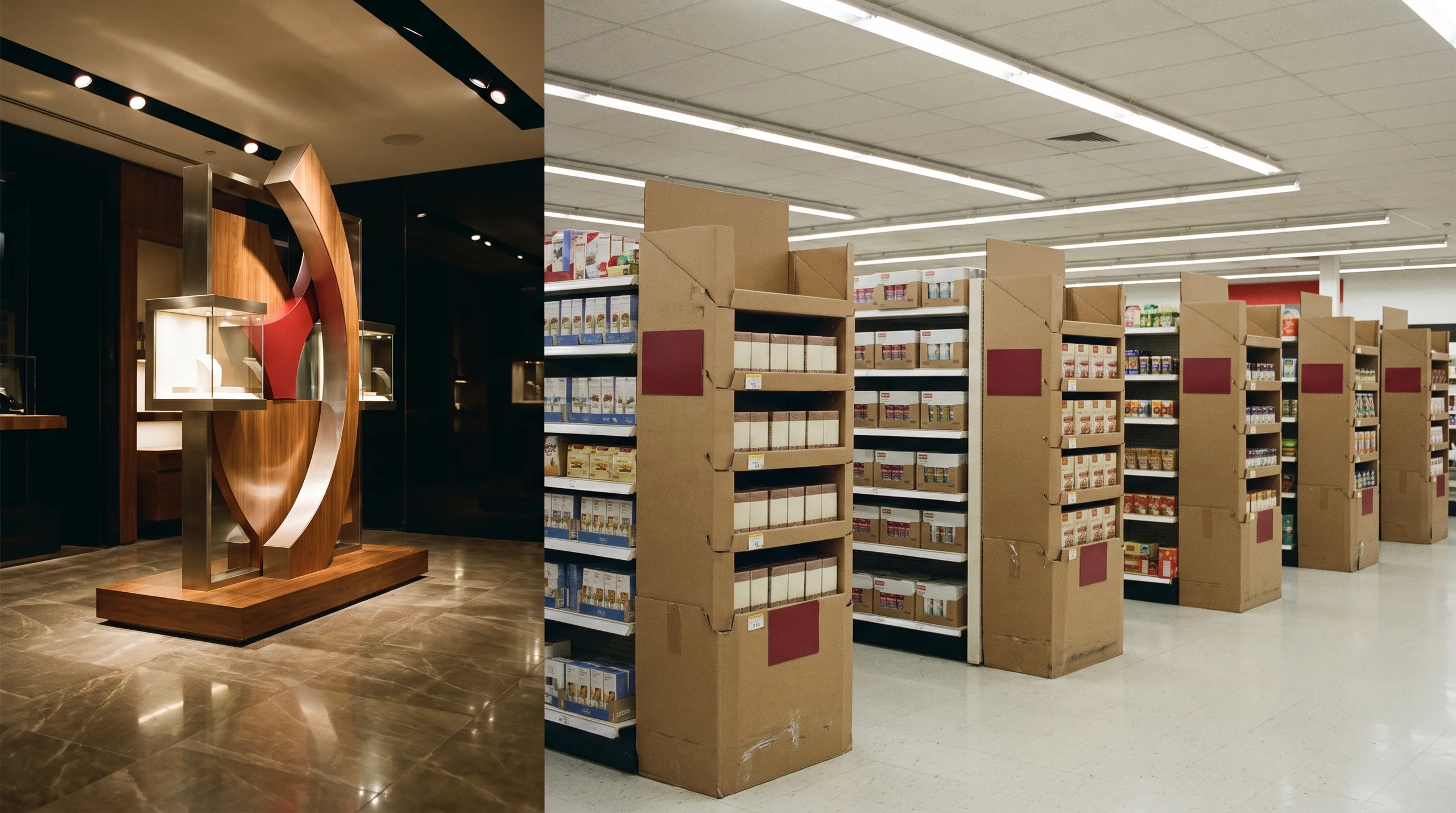
Three flagship builds and a forty-store rollout are not the same money spent at different scales. Flagships buy images, ambition and one strong retailer relationship. A rollout buys presence where the category is actually bought, and a sample large enough to prove something. The split follows from one question: does this campaign have to be seen, or does it have to be bought?
What the flagships buy
A build that cannot be repeated. Bespoke fabrication, real materials, lighting, an overnight installation by a crew. None of that survives being multiplied by forty.
An easier negotiation. A chain's own flagship benefits from looking impressive, so you are talking to someone whose interests align with yours.
Assets. The photographs and film the rest of the campaign runs on come from these sites. Worth planning for rather than collecting by accident.
The limitation is who walks through them: often a tourist, a city-centre commuter or a category enthusiast, not the person who buys the product every fortnight in a supermarket.
What the rollout buys
Repetition where it counts. Presence in the stores that already sell most of the volume.
A measurable result. This is the underrated one. Three sites cannot produce a comparison anyone should trust. Forty can be split against a matched group and produce a number that survives scrutiny.
The constraint is design: everything collapses to what one fitter can install alone, shipped flat, surviving months of restocking.
The cost curves are not the same shape
A flagship is mostly design, bespoke production and installation labour. There are almost no economies of scale — three costs roughly three times one.
A rollout inverts that at the front. Tooling, artwork and setup are paid once and spread across units, so the marginal unit is cheap. Logistics and installation, though, scale linearly with store count, and are usually the larger half of the invoice.
The consequence is a floor: a rollout too small to amortise its setup pays flagship-style overheads for supermarket-grade units. Below that point, cutting stores to save money makes each remaining store more expensive.
How to decide
- What is missing — awareness, or availability? Flagships fix the first, rollouts the second.
- Where does the category actually get bought, and are those stores on the rollout list?
- Does the retailer give you the forty, or only the three? The answer often makes this decision for you.
- Can you name in advance the number that would move? If not, the flagship option is the honest one, because it is bought for reasons other than sell-out.
The split that usually fails is the even one: a hero too small to be impressive and a rollout too small to be measurable. If the budget will not stretch to both properly, do one properly.
One rule worth holding: never fund the hero out of the rollout's installation line. Installation is not a contingency; it is what makes the rollout exist.
How to know which half worked
Instrument them separately, because they answer different questions. For the flagships: whether the images are still in use months later, and whether the retailer wants to repeat next season. For the rollout: sell-out against matched stores, and the proportion of sites where the unit actually went up and stayed up.